
India withdraws order for smartphone makers to install government security app amid UPROAR over privacy

[ad_1]
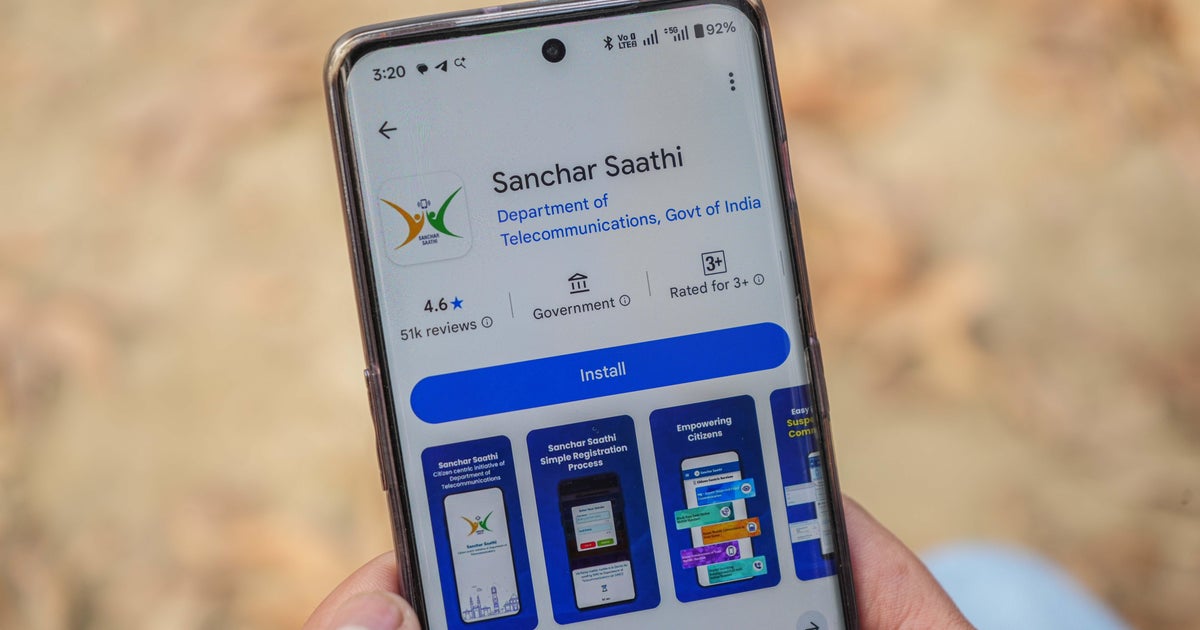
New Delhi – The Indian government reversed an order on Wednesday that had directed software makers such as Apple and Samsung to install a government-developed security app on all new devices. The move came after two days of criticism from politicians and secret societies that the “SANCHAR Saathi” app was an attempt to install on citizens through their phones.
“The government has decided to crack down on pre-installation fraud by mobile phone manufacturers,” India’s Ministry of Communications said in a statement on Wednesday afternoon.
The first order, issued privately by the phone makers in the service last month, hit Indian news outlets on Monday. Directed all phone makers to organize SANCARAR SAATHI (meaning social media partners in Hindi app) on new phones within 90 days, and also on older phones through software updates.
Finddous Nazir / Nurphoto / Getty
The order, reported since Monday by several Indian media outlets and later approved by the government, asked manufacturers to ensure that the functions of the application could not be “disabled or limited.”
There was a swift backlash on Monday, with opposition political parties quickly calling the government software a “mocking app” and drawing parallels to Pegasus, a hacking spyware developed, sold and licensed to governments around the world by The Israeli company is part of the group.
On Tuesday, India’s Communications Minister Jyotiraditya Scindia insisted to reporters outside Parliament that the Sanchar Sathi program is mandatory and in line with democratic principles. He said smartphone owners can use the app at their convenience to access its benefits, and they can remove the devices at any time.
He did not, however, say anything on Tuesday to deny or change the order for these phone makers to ensure that the application is pre-installed.
On Wednesday, Scindia insisted that “it can’t be done, and it can’t be done” with the app.
Vipin Kumar / Hindustan Times / Getty 
While the order for it to be installed worldwide was canceled, the government continued to defend the application on Wednesday, saying that the purpose was to “provide that” they are “protected and protected to help citizens.”
Opposition Politicians say “It’s a mockery”
The government’s reversal came after sharp criticism from political groups and digital rights advocates.
“It’s a snooping app. It’s ridiculous. Citizens have the right to privacy. Everyone should have the right to privacy to send messages to the family,” he told reporters outside the Indian Parliament on Tuesday.
“They brought in Pegasus and failed to control it. MPS and MLAs all say their phones have been tapped. This is a real loss of national security,” said Renuka Chowdhury, another Congress member.
Digital privacy advocates also raised concerns about the government order, saying it would violate citizens’ right to privacy in a country with more than 1.2 billion users.
“No government will ever be expected to admit that a government tool is a tool of shame, even in China and Russia, where such applications have been approved,” Indian Technology Analyst Prasanto K. Roy told CBS News on Wednesday. “The government’s statement alone is not enough to inspire confidence in this.”
Roy said the government should limit automatic permission settings that give apps access to data on smartphones to an absolute minimum, and explain why those permissions are considered necessary. He added that the app’s code should be open source and published online, to enable independent security experts to test it.
“In plain words, this turns every smartphone sold in India into a boatload of government-approved software that the user can’t reject, control,” the Internet Freedom Movement said in a statement. “For this to work, the app will likely need system level or root level access…to be modified. That scried option is raised by one observation, which is not compatible with the detection of penetration inside the Indian Sysy app.”
Technology analyst Roy Roy told CBS News The real story “doesn’t show faith in the government’s design or within the laws,” as there was no clarity about what data could be found in it.
The major phone makers have not publicly responded to the government order, but Reuters News Agency reported that Apple planned to refuse to comply.
The Indian government says it is just trying to help
The government points out that the application allows users to track, block and recover lost or stolen smartphones using the mobile device identity (IMEI), a unique code assigned to all handsets sold worldwide.
It also enables users to check how many unique details of data are registered under their name, which it says will help people identify and disable fake numbers and accounts opened by scammers.
Other features include tools to report suspected fraudulent calls and verify the authenticity of devices used to make purchases, according to officials.
The government said in several statements that the app has already been downloaded 14 million times, and is being used to help track lost or stolen phones. Sachar Sathi says he has helped connect more than 4 million connections, based on citizen reports.