GORDON SANDLAND: The mindset of perpetual war will not end the conflict in Ukraine – realpolitik is powerful

[ad_1]
NEWNow you can listen to Fox News articles!
For three years, Washington’s foreign policy establishment has insisted that there is only one acceptable outcome for Ukraine: total victory over Russia achieved with unending military aid, unending financial support, and readiness to escalate regardless of the risks. But strategy and discipline are not always the same thing – and real leadership wants to face reality as it is, not as we wish it to be.
I am not writing this as a scientist or mathematician, but as someone who has worked at the center of this conflict. As the US ambassador to the European Union during the first Trump administration, President Donald Trump tasked me with getting Europe aligned—really aligned—after Ukraine.
That meant ending the EU’s double game: declaring solidarity with Kyiv while enriching Moscow with buying power and dragging its feet on harsh sanctions. I saw firsthand that Europe’s skepticism and approach to trade was sending the wrong message to Moscow. It told President Vladimir Putin that the West is divided, apathetic and unwilling to sacrifice comfort for principles. That idea was part of his calculation.
PUTIN SEEKS TO WIN UKRAINE IN NEW YEAR’S ADDRESS Amid TRUMP-BACKED PEACE SPEECH
The sad truth is that the United States is closer to strategic exhaustion than our rhetoric allows. Europe’s defense industries remain underdeveloped. American stocks are limited. And although Russia paid a staggering price, it never folded, surrendered, or reversed course. Worse, every escalation increases the likelihood of the unthinkable: a desperate Kremlin turning to tactical nuclear weapons. That would not be “just another step” on the ascending ladder; it would destroy global stability.
Against that background, the Trump administration’s desire for a business solution is not a weakness. Classic realpolitik—the recognition that the task of American leadership is to increase US security, economic strength, and strategic flexibility while minimizing existential risks.
Business leaders know what Washington often doesn’t: perfect agreement rarely exists. The question is not whether we can reach a morally pure decision; whether we can lock in outcomes that are proportionately better for America’s interests—and Ukraine’s—than a perpetual, bleeding state.
A negotiated settlement, supported by compelling circumstances and power, can do just that.
First, compensation would provide Ukraine with an unexpected security guarantee—credible enough to deter renewed aggression but designed to avoid NATO’s Article 5 capture. This is not a vague promise; it is a contract with clear performance terms. The US guarantee will stand as long as Russia sticks to its commitments. But if Russia violates the agreement, the snapback provisions will start immediately – not after months, not after the diplomatic conflict – immediately opening the full support of the US and NATO for Ukraine, including offensive weapons, improved air defense, training and intelligence integration.
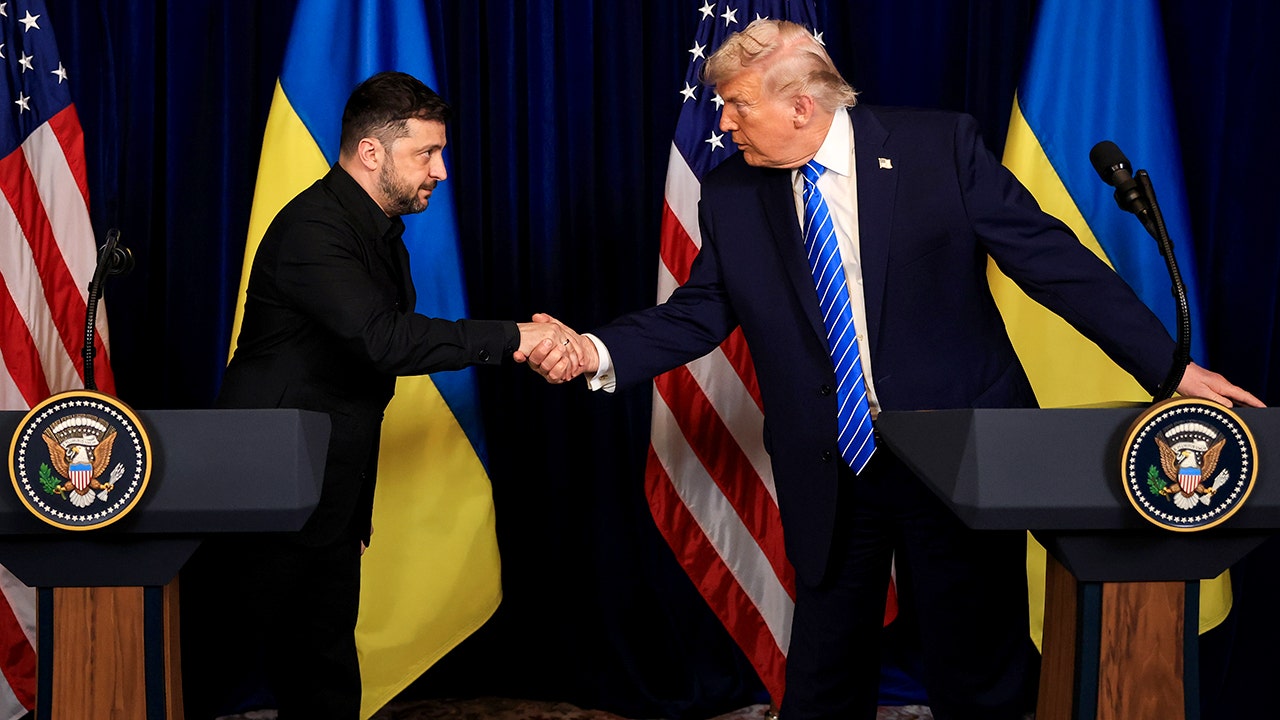
President Donald Trump and Ukrainian President Volodymyr Zelenskyy shake hands at a news conference following a meeting at Trump’s Mar-a-Lago club on December 28, 2025, in Palm Beach, Florida. (Joe Raedle/Getty Images)
TRUMP PUSHES FOR PEACE IN EUROPE, PUSHED IN AMERICA — BETWEEN TWO GAMBLE
Most importantly, the consequences of Russian cheating will be obvious, not theoretical:
If Moscow reneges on the deal, the United States will reserve the option to publicly return Ukraine to return the entire territory—up to and including a return to its pre-2014 borders. Moscow will know this. Deterrence works best when the penalties are clear.
And most importantly, all of this will be public. No more pretense, hedging, or silent back-channel deployments. The world—and Russia—will know that renewed aggression automatically and legitimately unleashes Western support, with the US leading confidently and unapologetically. That clarity is an obstacle in itself.
ZELENSKY SAYS WE’RE CLOSER AFTER TRUMP’S MEETING BUT THE PLACE STILL HAS RESULTS
Equally important, this structure protects US sovereignty in the treaty. If Ukraine violates its commitments, the American guarantee becomes null and void in our view. It is not a bureaucratic process. It is not a committee vote. The United States decides. That means Ukraine has every incentive to maintain discipline and not treat the arrangement as a blank check, but as a strong relationship based on commitment.
Second, a negotiated agreement would produce tangible economic benefits for the US. Ukraine holds minerals and rare earths important to American industry, national security, and technological superiority. China knows this. Russia knows this. Only Washington’s old guard pretends resource control is not strategic policy. A strategic agreement that guarantees the US privileged access strengthens productivity, energy resilience, and economic security.
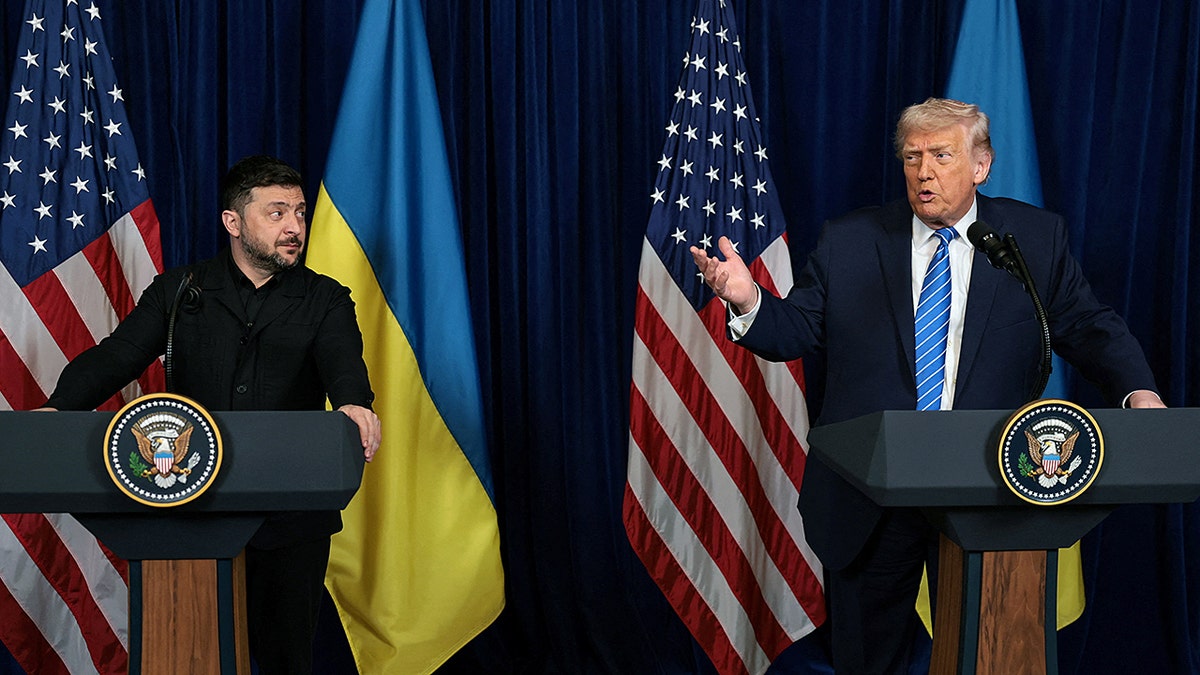
Ukrainian President Volodymyr Zelenskiy listens to U.S. President Donald Trump, after Trump said Russian President Vladimir Putin expressed his willingness to help Ukraine “succeed,” during a press conference at Trump’s Mar-a-Lago club in Palm Beach, Florida, on December 28, 2025. (Reuters/Jonathan Ernst)
Third, the agreement could open relations between Moscow and Beijing. Currently, the war has pushed Russia completely into China’s arms. That alignment is bad for the United States and the world balance. Directed maintenance begins to release those dependencies. America does not need friendship with Moscow; it needs power over it. Realpolitik is about profit, not love.
PUTIN REJECTS KEY PARTS OF OUR PEACE PLAN AS KREMLIN OFFICIAL WARNS EUROPE FACES NEW RISK OF WAR: REPORT
Fourth, the agreement can separate strategic theaters. If Russia insists on regional influence, the US can seek a common space in our region—especially in Venezuela, drug interdiction, and criminal networks linked to power—to limit the access of your adversaries to the Americas.
Critics will shout “Munich.” They always do. But Adolf Hitler led a growing ideological empire that aimed to conquer the world. Russia is a declining demographic and economic force seeking regional status. Cruel, yes—but not unreasonable. A mature force negotiates with competitors when negotiations produce superior results.
Some say that any feast rewards anger. That assumes that prevention is a binary thing—success or failure. In fact, prevention is limited.
UKRAINE-RUSSIA IN THE BODY: HOW THE WAR EVOLVED IN 2025 AND WHAT COMES NEXT
A solution that leaves Russia bloodied, sanctioned, strategically tied, and facing an automatic, extreme Western military escalation — possibly including US support for Ukraine to restore its 2013 borders — if cheating isn’t rewarded. It is a warning engraved on the stone of the covenant.
Meanwhile, personal and financial realities matter. Endless war means endless dead Ukrainians, ruined cities, and endless exposure to American taxpayers without a defined victory scenario. That might please thinking armies that have never fought wars, but it is not serious governance.
CLICK HERE TO VIEW MORE FOX NEWS
Most importantly, a corporate-style settlement introduces accountability—currently absent from Washington’s “as long as it takes” mantra. Under a structured agreement, compliance is measurable. Triggers are automatic. Support is not enhanced—guaranteed. Law enforcement is not an afterthought—it’s built in. And unlike today, America will no longer need to whisper about its involvement. It will do so clearly, implicitly, and with the authority of the agreement.
Another way? A perpetual war with increasing nuclear risks, continued strategic drift, and deepening alignment between Russia and China. That is not a strategy. Inertia dressed as courage.
CLICK HERE TO DOWNLOAD THE FOX NEWS PROGRAM
Realpolitik does not abandon values. He defends them wisely. A strong, enforceable resolution—with clear snapback provisions that benefit both the US and Ukraine; a clear mandate to liberally arm Ukraine and the ability to support full territorial recovery if Russia deviates; and a guarantee that is withdrawn at America’s discretion only if Ukraine violates the terms—it is not a waiver.
It is strategic control.
In geopolitics, as in business, the most powerful player is not the one who insists on endless confrontation. It knows when to fight—and when to cut a deal.
CLICK HERE TO READ MORE ON GORDON Sondland