
As China dominates the precious mineral, the US is protecting its tungsten source — and CBS News gets an exclusive look

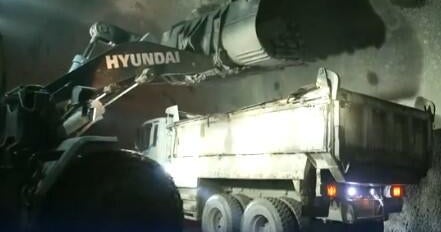
[ad_1]
Sangdong Mine, South Korea – Over the decades, China has come to rule rare earth and mineral industries, closing off the market in raw materials essential to every aspect of modern life, from cell phones to armor drills and AI missile guidance systems.
Beijing’s grip on the production of these precious metals and minerals has prompted an urgent investigation by US authorities to find alternative sources of supply.
Lewis Black says his company is ready to help fill the void, at least when it comes to supplying tungsten, a mineral he calls “vital” to US defense needs.
Black, CEO of Canadian mining company Almonty Industries, flew from New York to South Korea last week to give CBS News a tour of a mine that he hopes will soon produce enough tungsten to meet at least America’s emergency needs.
CBS News
Days before his flight to the Sangdong mine, Black met with US officials, including the White House, and signed an agreement guaranteeing that Almonty would, in the future, provide sufficient tungsten for US security needs.
Black said he could not discuss the details of the deal with the US government.
The great power of Tungsten
The strength of tungsten is based on the fact that it has the highest melting point of any element. While it is used in everyday things from electrical wires to semiconductors and batteries, its use in the defense industry makes it truly valuable.
“It’s important. It’s more than a criticism, it’s important,” Black told CBS News, standing in the large red tin-roofed building that houses his factory in Sangdong.
As he spoke, the machines that dismantled the metal – tungsten-embedded stones – were on the ground in slow motion, being tested to be ready for full operation later this year.
CBS News 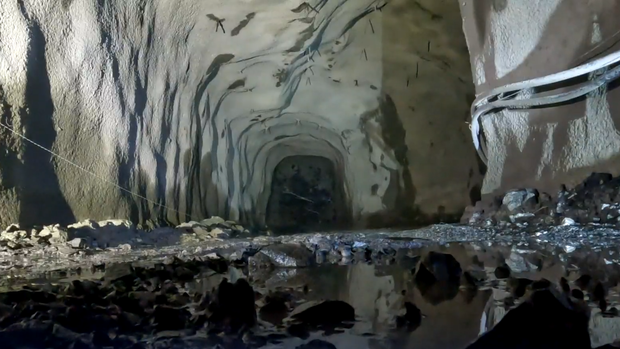
“It’s not just about things you can see like weapons and armor,” said Black. “You want to build armored vehicles? All engineering, all AI chips, AI chips you can’t build without tungsten gas. You want to build an airplane? Rockets, everything. It’s an important, small part, but without it, you can’t do it.”
The rise, fall and revival of the Sangdong tungsten mine
Tungsten was first discovered in a rocky area in the Sangdong area, about 115 kilometers southeast of Seoul, in 1906. A Japanese company began mining there about ten years later, and the tungsten extracted was later used for the Japanese war machine during World War II.
The end of that war ended Japan’s occupation of the Korean Peninsula, and the Sangdong mine returned to Korean control. It will continue to have a significant impact on South Korea’s economy, at one point accounting for 30% of the country’s GDP.
CBS News 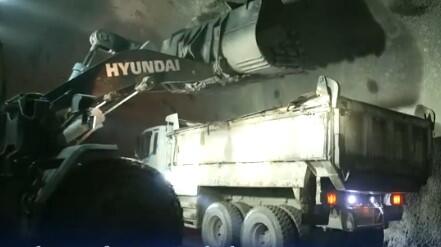
South Korean presidents visited the mine at least six times – it was a source of national pride. But in the 1990s, it fell victim to China’s anti-dumping policies and was liquidated.
Over the next three decades, the US, along with many other Western nations, benefited from the cheap, state-subsidized goods produced by China.
But that advantage became a trust, and it left Washington exposed and vulnerable in the interim trade war with China What has been seen is that Beijing is imposing export restrictions on rare earths and other valuable items.
In response, there has been a rush to establish alternative supply chains.
China controls at least 80% of the world’s current tungsten supplies, according to Almonty, while Russia and North Korea both have a small but significant share of supplies.
Almonty Industries is in the process of moving its headquarters to New York. It’s a clear indication that the US government has become a very important part of Black business – its biggest customer, in fact.
Almonty took ownership of the Sandong mine in 2015.
Meeting with China will be “disturbing”
Almonty also has tungsten mines in Spain and Portugal, and recently bought one in Montana, mainly out of interest, Black said, in US homeland security.
“With the American government, it is one of the reasons why we took the mine in the US — it brought our technology to the country so that we can start producing more people for a long time,” he said. “To me, it feels good that the legacy of the company fills the gap that has been left open.”
Black said the Montana mine won’t be operational for years, however, as Almonty still needs to obtain permits and train workers. Everything is the same, he noted, in the big problem that the US and its Western partners have as they want to free themselves from the dependence of the supply chain on China; it will take a long time.
“China owns many different sectors, whether it’s rare earth, lithium, graphite, tin, lead, aluminum,” said Black, adding that during the last eighty years many such industries “became unpopular in the West, and we threw away the raw materials.”
There are recently discovered sources of other important materials, especially in Africa, as well The US has sought to build business ties there – but Black says China has “laid a lot of groundwork,” already protecting investment in many African countries through its “Belt and Road” initiative.
He believes it will take at least a decade for the US to completely decentralize its supply chains, not least because of the need to train workers.
“We don’t have the people to run these mines,” Black told CBS News. “The US and the West have something to do.”
For now, he expects the US industry to face some disruption.
“I bought this 10 years ago,” he said of the Sangdong facility. “Democratic mining is a journey, not for the faint of heart.”
Black expects “it’s going to be a really tough, sad journey” as industries like the U.S. auto sector work to free themselves from cheap Chinese raw materials.
“You want to offshore all this production but you don’t have the means to produce the parts that will supply this product. This has to be done… It will be disruptive, there will be times when some sectors will run out of parts – that is inevitable. In this instance, everyone will just pull it and just move on, because it can only be done.”
A few months ago the US Defense Logistics Agency filed a Request for Information (RFI) for tungsten – effectively an SOS call for the precious mineral, surprising some in the industry as it effectively exposed the US shortage.
“I think the US government is saying, ‘Okay, whatever we can find, we better hide it while we build this supply chain,'” Black said.
He expects Sangdong to be operational in the first quarter of 2026, and when it is, it should operate 16 hours a day, with the associated processing plant operating 24 hours a day, producing an estimated 1.2 million tons of tungsten ore annually.